
Data literacy helps people ask what a number represents before drawing conclusions.
Consider a service manager interpreting a monthly performance dashboard. The difficulties in this situation are easy to describe in general terms but harder to resolve in the daily routine. A good starting point is to examine a real example from beginning to end: what happened, which information was available, and how the people involved decided what to do next. That makes the problem concrete rather than simply a request for more technology.
A training programme should distinguish knowledge from performance. A person may remember definitions but be unable to complete a task when a different document or device appears. Observe what learners can do independently, which parts require help and what resources they consult. This information supports a more realistic plan than a single self-assessment score or a test of isolated terminology.
Define the Starting Conditions
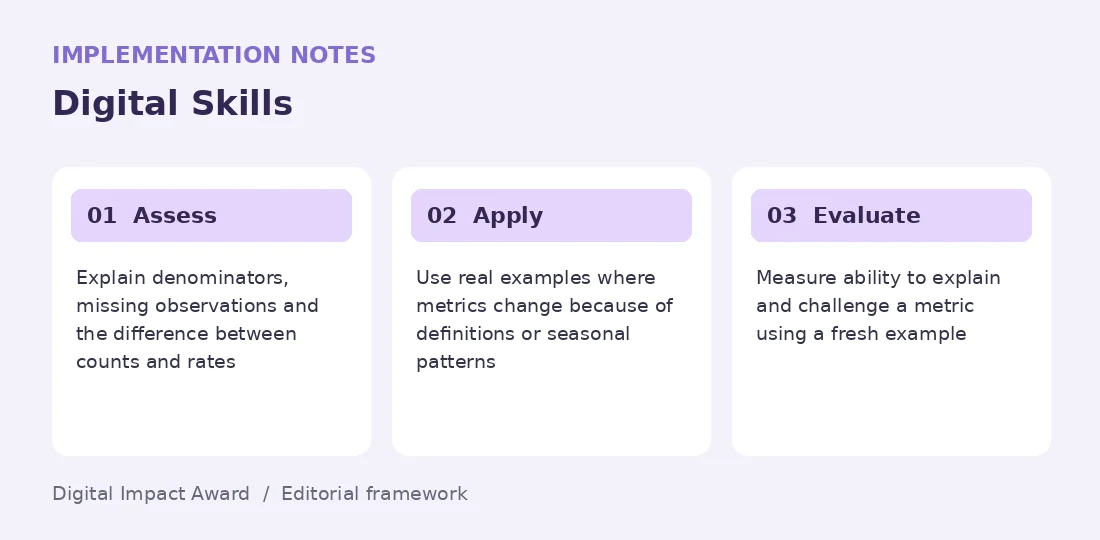
Explain denominators, missing observations and the difference between counts and rates.
Start with the people and records involved in the example of a service manager interpreting a monthly performance dashboard. Ask each participant to describe an ordinary instance and one particularly difficult instance. In many organisations the official description of a process differs from what people do when information is missing. Comparing the two helps identify the conditions that create the most effort. A small, descriptive sample of actual work can be more revealing than an extensive questionnaire that asks people to remember how things usually happen.
A percentage is incomplete without its denominator. If customer complaints fall from one period to another, check the number of transactions as well as the count of complaints. Give learners an example with missing records and ask whether a comparison remains reliable. The goal is to make limitations visible, not to discourage the use of data.
Make the First Change Manageable
Use real examples where metrics change because of definitions or seasonal patterns.
The initial change should be small enough to reverse or revise. Determine which existing steps must remain available during the test and what conditions would require the trial to be paused. Assign responsibility for the work rather than leaving a general expectation that somebody will deal with errors. People who encounter a difficult case need an established place to record it and a workable way to complete their original task.
Different learners bring different experience and access to equipment. Give people room to practise privately, make mistakes and ask for help without being embarrassed. Use examples that reflect their actual role and provide alternatives for people who need accessible materials. A short exercise followed by practical application and feedback is often easier to retain than a long presentation covering dozens of functions.
Write down the scope of the first release in specific terms. Include what it will cover, what it will deliberately exclude and the information required for each action. If a necessary part of the change cannot be examined independently, break it into observable stages. This makes the next review easier because the team can distinguish shortcomings in the design from difficulties caused by incomplete preparation.
Test the Approach Under Ordinary Conditions
The practical trial should include both the common sequence and the awkward situations identified during assessment. In the example of a service manager interpreting a monthly performance dashboard, arrange for the relevant people to perform their normal work with the changed process. Watch where they pause, leave the task, produce an incomplete result or seek an alternative route. It is helpful to ask what they expected to happen, since the visible mistake may originate in an unclear instruction or an assumption made elsewhere.
Avoid changing several unrelated factors at once. When a trial includes new rules, new software and a reorganisation of responsibilities simultaneously, the team may be unable to determine which change produced an observed difference. Keep comparable examples from the earlier process, make the trial boundary explicit and record interruptions. The aim is to gain evidence that is informative enough to guide the next decision, not to demonstrate that the initial proposal was correct.
Measure Outcomes, Not Activity
Measure ability to explain and challenge a metric using a fresh example.
Agree on the unit of observation before collecting results. A percentage can be calculated in more than one way, and a monthly total may conceal considerable variation between different kinds of work. Explain which records are counted and which are excluded. Where a result takes time to emerge, choose an observation period long enough to include that delay. If a small sample produces an encouraging difference, treat it as provisional rather than projecting it across the entire organisation.
Cost should include work that is less visible in a budget: training, checking exceptions, integrating information, repeated support requests and correcting mistakes after completion. A shorter task may require more preparation somewhere else. Similarly, a higher volume of completed work may not improve the outcome if quality drops. Review the relevant measures together and take account of how their relationships change under different operating conditions.
Where the Approach Can Fail
Statistical terminology without practical context is easily forgotten.
This is a useful point at which to revisit the original assumptions. Identify the situation in which the proposed approach would be least appropriate. Some shortcomings can be addressed through a change to the design, others by reducing the scope of the solution, and some indicate that the cost of proceeding is too high. Record the difference. A limitation that matters to an occasional user might have little impact in one setting and be unacceptable in another.
People need a route for resolving a problem when the normal procedure fails. Establish how to identify the error, who can make a correction and what associated records need to change. The fallback should be tested during the trial rather than left for the first real breakdown. An improvement that depends on perfect inputs or uninterrupted connectivity is likely to require additional safeguards before it can be relied on in everyday operations.
Responsibilities After the Initial Rollout
Identify who will take ownership after the original project team has moved on. Someone should be responsible for reviewing the design when business requirements change, keeping guidance accurate, and inspecting recurring errors. Document the ordinary maintenance tasks and estimate the time they require. If that time is not protected, a system that initially performs well may gradually accumulate inconsistent records or outdated assumptions.
Useful documentation can be brief. Describe the agreed starting conditions, the actual decisions made during implementation, and the definition of each measure. Include examples of the unusual cases from a service manager interpreting a monthly performance dashboard. Keep this material accessible to the people responsible for the work. The test of the documentation is whether a person familiar with the role but absent from the original project can use it to make a correct decision.
A Practical Review Before Expanding
Before committing more resources, compare the trial with the baseline and review the remaining uncertainties. Decide which outcomes justify continuing, which require further examination and which would justify stopping. Take into account the users and cases that were not represented in the first test. A process that works for a small team with extensive informal support may need additional structure before another department or location can use it reliably.
A related perspective is available in Upskilling for the AI-Assisted Workplace, which examines another part of the same subject. The discussion of the first european digital impact awards also provides useful context for the decisions involved. Read these alongside the specific requirements, constraints and observations of the project rather than adopting a universal template.
A sensible final review records the decision and its reasoning: which evidence mattered, what remains uncertain, and what should be revisited at the next review. If the project is extended, preserve the original records so that later results can be compared with the initial change. If the approach is replaced, retain what the trial established about the problem. That knowledge may be valuable even when the first proposed solution is not.