
On 7 November 2013, the first European Ada Awards were presented in connection with the ICT 2013 event. Their categories recognised digital achievement by girls and women, as well as organisations supporting greater participation in technology. The awards were associated with wider European work on digital skills and employment. This reconstructed feature uses the date of contemporary reporting, 10 November 2013, and was prepared in 2026.
The organisational category brought attention to more than individual excellence. It focused on the structures that determine who gains experience with computing: access to equipment, teaching, encouragement and realistic pathways into further study. The early awards offer a useful historical reference point for examining the long-running effort to make technology education more accessible.
The following discussion looks at the historical context and its relevance to present-day digital participation. It does not imply that the original award programme is still accepting entries or that these initiatives are operating unchanged today.
The Historical Setting
Historical initiatives placed emphasis on learners and organisations as well as individual careers. This structure is worth noting because participation is affected by access to equipment, opportunities to practise and encouragement to continue. Comparing initiatives requires attention to their actual activities and the period in which they took place, rather than assuming the same methods apply unchanged today.
The period in which these awards took place saw sustained attention to digital education, access to computing and participation in technical employment. The awards connected practical achievements with these broader concerns. The historical record is best read in its original context: the participants were recognised for work conducted in that period, and the categories reflected the priorities of the organisers at the time. Later developments should not be attributed to the awards without separate evidence.
The account can be considered alongside other historical examples in the publication's archive. The purpose of retaining this material is to preserve the subject of the earlier report, including its relationship to digital inclusion and education. The reconstructed text is not a verbatim copy of the original announcement. No current application process or commercial association is being represented.
What Digital Participation Involved
Digital participation goes beyond possession of a device or access to an internet connection. People need the opportunity to practise a skill, receive feedback and encounter problems that make the skill useful. In the context of these historical awards, the recognition of organisations drew attention to the role of teaching, mentoring and established routes into more advanced technical work.
Different learners bring different experience and access to equipment. Give people room to practise privately, make mistakes and ask for help without being embarrassed. Use examples that reflect their actual role and provide alternatives for people who need accessible materials. A short exercise followed by practical application and feedback is often easier to retain than a long presentation covering dozens of functions.
Practical activities can help learners build familiarity with the vocabulary and working methods of computing. Opportunities to discuss careers with experienced practitioners may also reveal different routes into a technical subject. However, an individual learning experience is shaped by prior opportunities, equipment, time and the support available outside formal sessions. The success of a programme cannot be inferred solely from the number of people who attend it.
Practical Access to Learning
The availability of entry-level learning opportunities matters because a person who has never worked with a programming environment may not consider a technical career a realistic option. Informal workshops, supervised projects and opportunities to meet people in technical roles can offer a low-pressure way to explore a new subject. Their usefulness depends on whether participants have a meaningful task to perform and a way to keep learning once the activity is complete.
Education providers and employers can examine access by looking at who hears about an opportunity, who is able to attend and what practical support they need. An initiative advertised through a familiar professional network will not necessarily reach people whose families have no previous connection to technical work. Timing, travel, equipment and entry requirements therefore form part of the design of a learning programme, even though they may be absent from the teaching materials.
How to Assess Progress
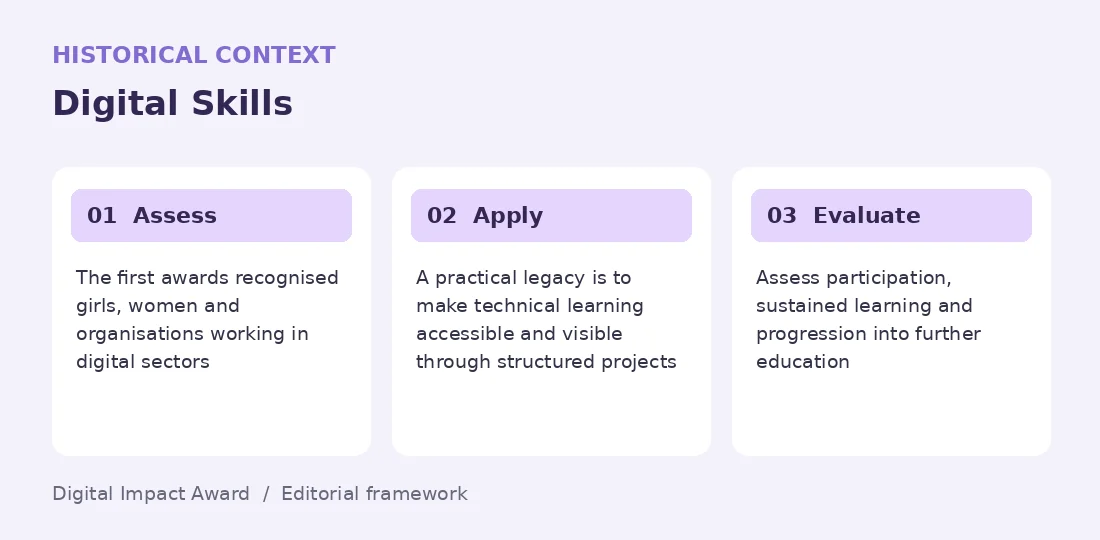
Assess participation, sustained learning and progression into further education.
Assessing inclusion initiatives requires careful interpretation of the available information. Participation provides an indication of reach, but it does not establish how much was learnt or whether the participant returned to the subject later. Where possible, compare experience over time and look at which barriers persist. Learner feedback, practical exercises and evidence of independent work may complement attendance records.
A programme working with children or young adults should also consider privacy when analysing participation. Reports can describe patterns in broad groups without exposing unnecessary personal information. If a programme has a small number of participants, aggregate information carefully and avoid drawing broad conclusions from a single cohort. Clear reporting about the scope of the activity is more useful than an unsupported assertion of long-term impact.
Limitations of Recognition
Recognition cannot replace the resources required to improve access.
An award creates visibility for selected examples. It does not provide a complete inventory of the educational projects undertaken in a region, nor does it guarantee that all effective programmes were represented. Selection reflects the available nominations and the criteria used at the time. For that reason, historical achievements are most useful when interpreted as examples within a wider field of activity.
Continued learning requires practical resources and sustained support. An organisation may be able to deliver a successful workshop without having the resources to offer further training. A learner may be enthusiastic at an event but have little access to equipment at home. These realities should be considered when using the historical examples to inform current decisions.
Relevance to Later Digital Inclusion Work
Current education and workplace programmes still face questions that are recognisable from the archive: how to introduce a technical subject in an accessible way, how to make further study available, and how to provide feedback that helps people become independent. Specific technologies have changed since the original award years, but the need for realistic opportunities to learn remains relevant.
Employers, educators and community groups can review their own approach by discussing the concrete barriers learners experience. Accessible materials, reliable equipment, approachable instructors and transparent selection criteria each address different aspects of participation. A programme need not adopt the format of a historical award to apply those lessons. What matters is the experience available to the people it is intended to support.
Reading the Archive Today
Readers interested in the broader context can explore the archive and contemporary coverage of digital skills. The distinction between historical reporting and present-day analysis is important. Original announcement dates are retained where known; new material is organised by editorial chronology while its actual publication metadata retains the publication date. A reconstructed archive item records the earlier subject and places it in context without pretending to reproduce every detail of the former webpage.
See also Women in Technology: Building More Accessible Career Pathways and Digital Safety Skills for Everyday Work for related perspectives. The earlier award cycle is closed, and there is no entry form or registration process on this publication.